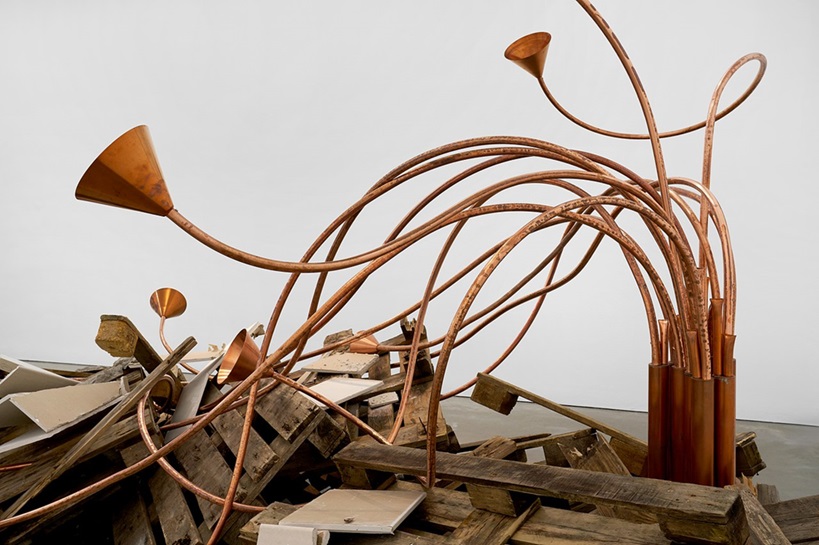
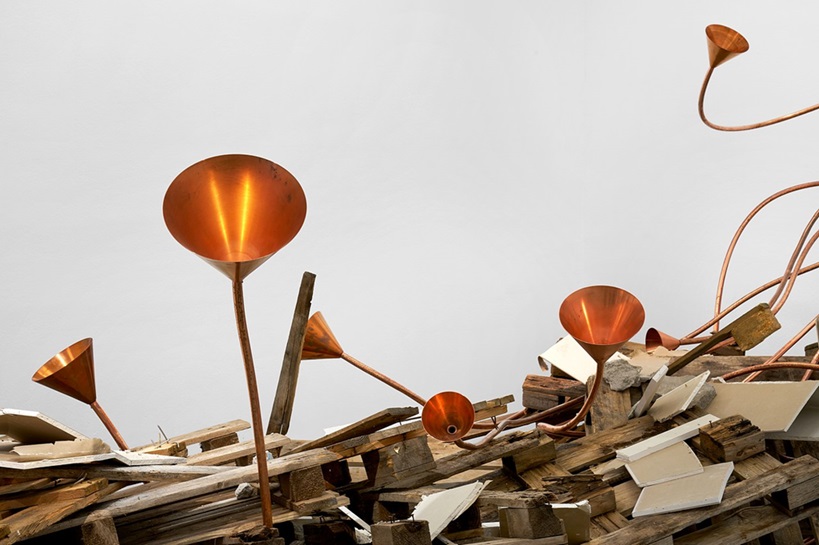
Rebecca Horn’s Concert of Sighs fills the space of Galerie Thomas Schulte, with the echoes muted whispers, which emanate from coiled copper trumpets jutting out of rubble. Piled on the floor are building pallets, wall fragments, and wooden boards, lay strewn in piles on the floor from which thin copper tubes wind like plant shoots, ending in funnel-like trumpet mouths. The artist used building materials from the ruins of Venetian houses for her installation, which was originally created for the 1997 Venice Biennale. Whispers and sighs seep through the individual funnel trumpets, as if offering a mouthpiece to the life beneath the ruins, or as if the crumbling walls of Venice were telling us their story. These delicate, yet haunting sounds, make the skin crawl, as the voices, audible in several languages, lament their suffering. As viewers, we do not merely hear the “concert of sighs”, we feel it as a physical and visceral experience. This work serves as a further testament to Horn’s mastery of sensory orchestrating: enveloping all our senses from balance to touch as the echoing sighs seep through our skin. As we stand closer to the work, we feel its innate fragility; fearing that at any moment, a piece could fall, slip, and crush the copper pipes from which the sounds flow. Through our sense of balance, our bodies resonate with Rebecca Horn’s installation. On the one hand, we embark on a journey to Venice; on the other, we are confronted with a more wholistic sense of chaos and destruction. Thus, it is its inherent multisensory power that makes the Concert of Sighs so significant. The work challenges our sense of balance, the solidness of the ground beneath our feet, and indeed, our sense of existential security. For Rebecca Horn, the body becomes a sensory commune in which the sense of touch—not sight—is the starting point and basis of a multisensory experience. The artist understands that touch encompasses the entire body and thus interacts with our other senses. We do not literally have to touch her works to see them embodied. It is a physically and emotionally activated perception that involves not only the touch of the hand, but the entire repertoire of the body’s materiality and its somatosensory experiences. It also draws on our depth sensitivity, pushing us to consider the position and dynamics of our bodies in space. As recent research in neuroaesthetics shows, hearing is also a specialized form of tactile perception that is limited to a specific area of the body. In this way, we learn and take in information through each sensory experience, which goes beyond our cognitive or psychological forms of knowledge production. When we listen to the sighs, when we see and feel the elements of the dilapidated Venetian houses, we gain an embodied wisdom and experience that the artist is sharing with us. One which transports us beyond the decays of Venice, but which confronts us with our own contemporary world, regardless of the city we live in. This stands in contrast to Marco Polo’s character in Italo Calvino’s novel The Invisible Cities, who—no matter what city he was talking about—always told the story of Venice. What Rebecca Horn and Marco Polo have in common, on the other hand, is aptly stated by the Great Khan in Calvino’s same novel: “Admit what you are smuggling: states of mind, states of grace, elegies!”
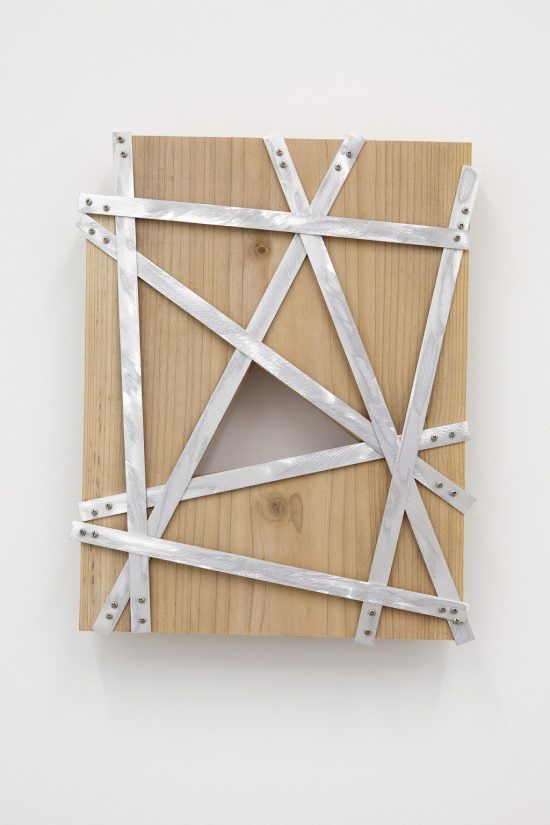
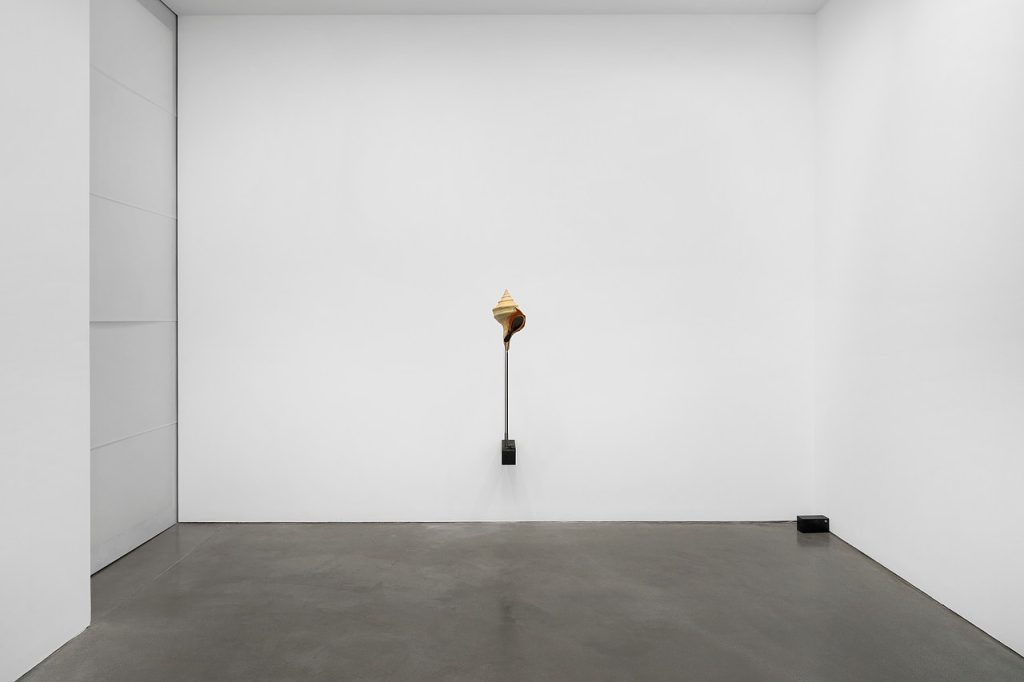
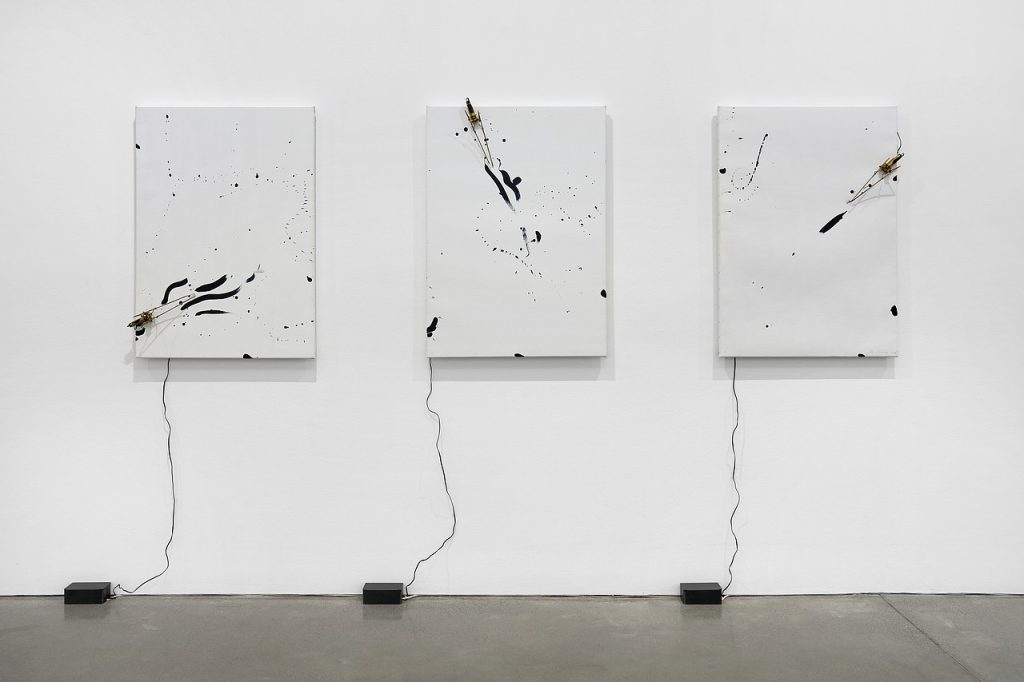
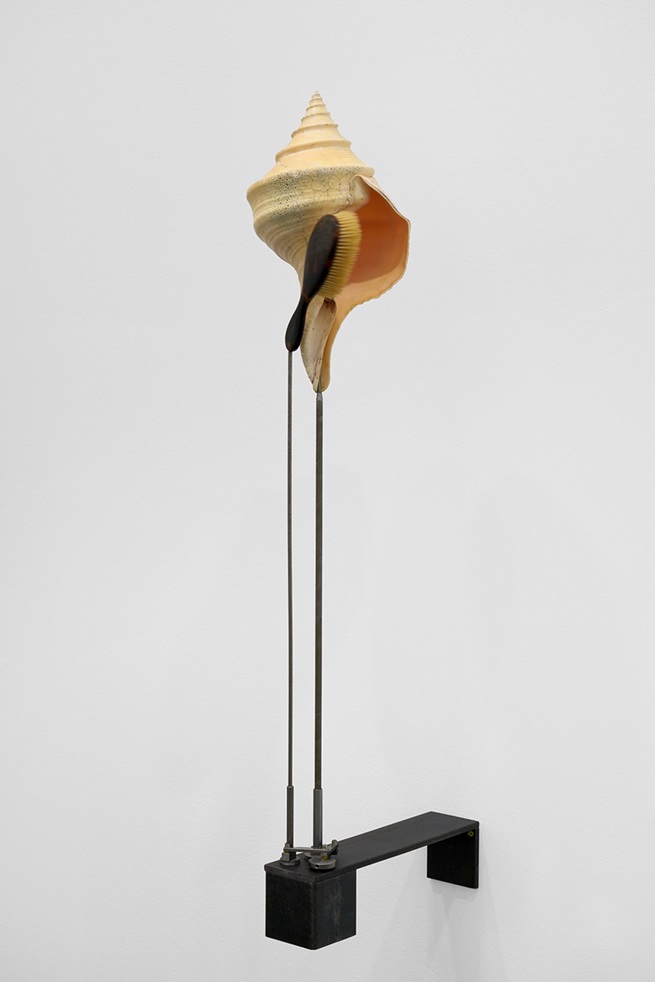
Alongside Concert of Sighs, stand two works, Raven’s Choice and Schlupfloch, which, in Horn’s similarly characteristic style, introduce a sensual lightness, a sense of humor and even erotic tone, which call up images of hair tickling our skin and pushing us to ask, where do sighs truly originate from?
Rebecca Horn composes a polyphony of senses—a visceral and physical experience opening at Galerie Thomas Schulte.
Text by Dr. Marta Smolińska Translation by Dr. Leonie Schulte
Shortly before the opening of the exhibition Concert of Sighs, Rebecca Horn passed away on 6 September, 2024 at the age of 80.
Rebecca Horn (born 1944 in Michelstadt, died in 2024 in Bad König, Hesse, Germany) since the early 1970s developed an autonomous, internationally renowned position beyond all conceptual, minimalist trends. Her work ranges from sculptural environments, installations, drawings, paintings to video and performance and manifests abundance, theatricality, sensuality, poetry, feminism, and body art. While it was mainly through her early performances that she explored the relationship between body and space, in her later work, the human body was replaced by kinetic sculptures. The element of physical danger that comes from machines, knives, and electricity is a constant theme throughout the artist’s work.
Having studied in Hamburg and London, from 1989, Rebecca Horn herself taught at the University of the Arts in Berlin for almost two decades. In 1972, she was the youngest artist to be invited by curator Harald Szeemann to present her work in documenta 5. Her work was later also included in documenta 6 (1977), 7 (1982) and 9 (1992) as well as in the Venice Biennale (1980; 1986; 1997; 2022), the Sydney Biennale (1982; 1988) and as part of Skulptur Projekte Münster (1987; 1997). Throughout her career she has received numerous awards including, Carnegie Prize (1988), Kaiserring der Stadt Goslar (1992), Praemium Imperiale Tokyo (2010), Pour le Mérite for Sciences and the Arts (2016), and most recently, the Wilhelm Lehmbruck Prize (2017). A first mid-career retrospective of her work was organized in 1993 by the Guggenheim Museum, New York, traveling to the Stedelijk Van Abbemuseum, Nationalgalerie Berlin, Kunsthalle Wien, Tate Gallery and Serpentine Gallery, London, and the Musée de Grenoble. Further retrospectives were presented at the Hayward Gallery in London in 2005, at Gropius-Bau in Berlin in 2006, at Centre Pompidou Metz and simoultaneously at Museum Tinguely in Basel in 2019. On the occasion of her 80th birthday, a retrospective has been presented at Haus der Kunst München in 2024.










Artist: Rebecca Horn
Title: Concert of Sighs
Venue: Galerie Thomas Schulte, Berlin
Dates: 11 September – 9 November 2024
©Galerie Thomas Schulte, Berlin